


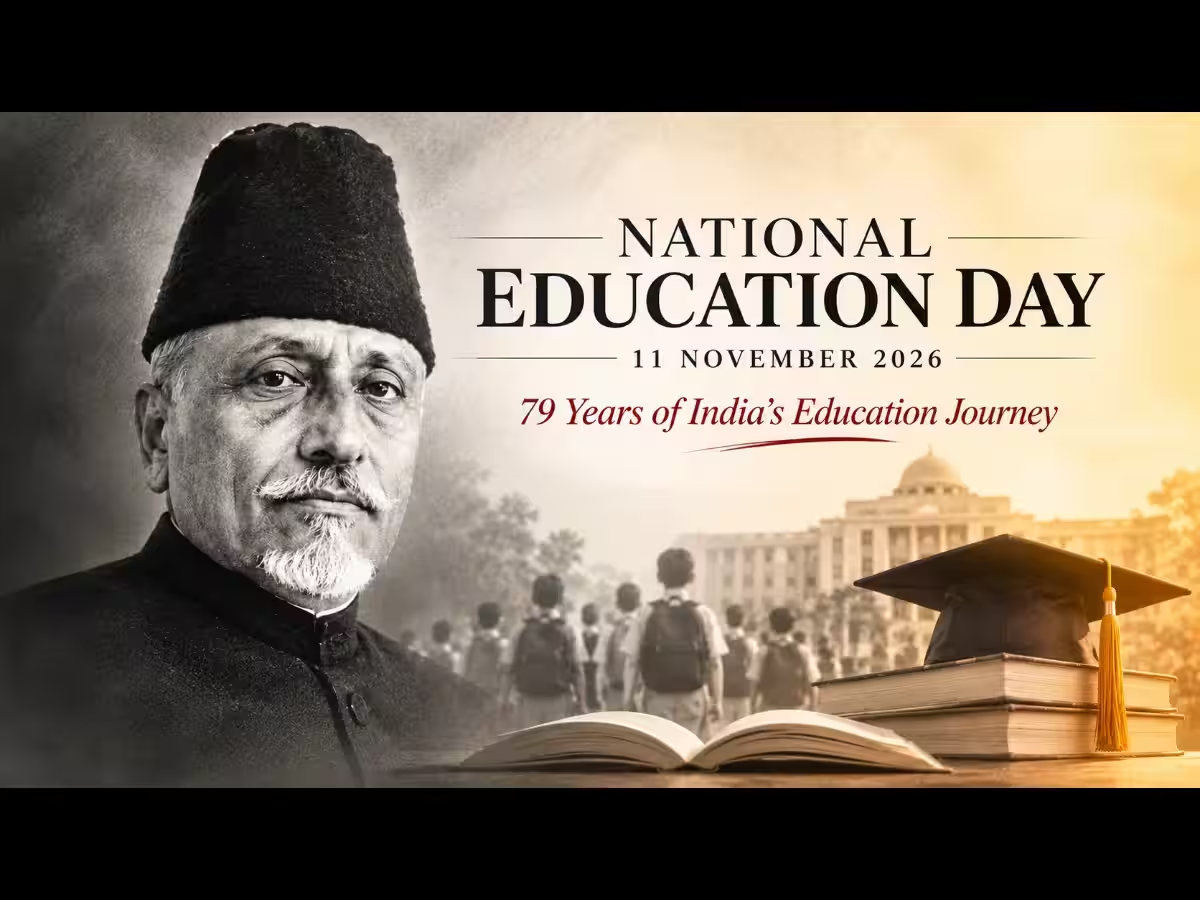
India’s education system has undergone a significant transformation since Independence, expanding access to schools and universities, increasing student enrolment and building institutions of national and global standing. Yet, nearly eight decades later, the larger question remains: has the country succeeded in translating this expansion into quality education, meaningful learning and equal opportunities for all?As India observes National Education Day on November 11, marking the birth anniversary of Maulana Abul Kalam Azad, the country’s first Education Minister, the occasion offers an opportunity to revisit his vision of an inclusive, modern and progressive education system and assess how far India has travelled in fulfilling it.Azad, who served as Education Minister from 1947 until his death in 1958, believed that education was central to nation-building. He advocated universal, free and compulsory primary education for children up to the age of 14, alongside greater opportunities for girls, vocational training, scientific education and the expansion of technical and higher education. His vision was not limited to increasing literacy but also focused on creating a society where education could contribute to social progress, cultural development and national advancement.During his tenure, India took important steps towards building its higher education and research infrastructure. The first Indian Institute of Technology was established at Kharagpur in 1951, while the University Grants Commission (UGC) was inaugurated in 1953. He also championed the development of institutions dedicated to India’s arts, literature and culture. These initiatives reflected his belief that a newly independent country needed a strong educational foundation to support its economic, scientific and intellectual ambitions.From expanding access to improving learning outcomesIndia’s education landscape today is considerably larger. According to the Ministry of Education’s UDISE+ 2025-26 report, the country has 14.67 lakh schools, 24.72 crore students and approximately 1.03 crore teachers. The pupil-teacher ratio stands at 10 at the foundational stage, 12 at the preparatory stage, 17 at the middle stage and 21 at the secondary stage.Higher education has also expanded. The All India Survey on Higher Education (AISHE) 2023-24 report puts India’s higher education Gross Enrolment Ratio (GER) at 30, compared with 23.7 in 2014-15. Female GER has increased to 31.2 from 22.9 during the same period, indicating greater participation of women in higher education.However, the expansion of the education system does not automatically translate into better learning outcomes. The focus is increasingly shifting towards whether students are acquiring foundational skills, developing the ability to think independently and applying classroom knowledge to real-world situations.The Annual Status of Education Report (ASER) 2024 offered some encouraging signs of recovery in rural learning levels. The proportion of Class 3 children who could perform at least subtraction increased to 33.7% in 2024 from 25.9% in 2022. Similarly, the proportion of Class 5 children who could solve a division problem rose to 30.7% from 25.6% during the same period. While the improvement is encouraging, the findings also underline the continuing challenge of ensuring that children acquire basic reading and numeracy skills at the appropriate stage.The National Education Policy (NEP) 2020 seeks to address several of these challenges by shifting the emphasis from rote learning towards conceptual understanding, critical thinking, multidisciplinary education, vocational exposure and holistic development. It also envisages raising the Gross Enrolment Ratio in higher education to 50% by 2035.Education must prepare students for a changing worldAs the nature of work and the skills required by employers continue to evolve, educationists believe that the purpose of education must extend beyond academic performance and examination results.Rati Chugh, Principal, Delhi Public School, Sector 45, Gurgaon, said education must focus on nurturing responsible, compassionate and confident individuals rather than being restricted to knowledge acquisition and academic excellence.“Education is not merely about acquiring knowledge or achieving academic excellence; it is about nurturing responsible, compassionate, and confident individuals who can contribute meaningfully to society. On National Education Day, we must reaffirm our commitment to creating learning environments that encourage curiosity, critical thinking, creativity, and lifelong learning, Chugh said.”In today’s rapidly evolving world, education must go beyond textbooks and examinations to equip students with the skills, values, and adaptability needed to navigate future challenges. It is equally important to recognise the role of teachers as facilitators who inspire young minds to question, explore, innovate, and discover their potential,” she said.Highlighting the importance of recognising individual abilities, Chugh added that every child has unique strengths and that schools must create opportunities for holistic development.”True education empowers individuals not just to succeed in life but also to make a positive difference in the world. As we celebrate National Education Day, let us work towards an inclusive, progressive, and value-driven education system that prepares students for life, not just for examinations,” she said.A similar emphasis on inquiry-led learning was highlighted by Shaheen Shafi, Principal, Heritage Xperiential Learning School, Noida. She said children must be encouraged to question, examine evidence and develop independent perspectives rather than simply focus on arriving at the right answers.”At Heritage Xperiential Learning School Noida, we believe a child’s questions deserve as much attention as their answers. Inquiry-led learning encourages children to examine evidence, consider different perspectives and think for themselves. These habits deepen when learning moves beyond the classroom into conversations, communities and everyday experiences. Education should help children make sense of the world and recognise their responsibility in shaping it,” Shafi said.Anju Sharma, Senior Principal, Phoenix Greens School of Learning, Kokapet, Hyderabad, also emphasised the need to connect classroom learning with real-world experiences and equip students with the confidence to respond to future challenges.”As the world continues to evolve, education must move beyond imparting knowledge and focus on preparing students to think independently, embrace new ideas and find meaningful solutions to the challenges ahead. The true purpose of learning is to equip children not just for the world as it exists today, but for the world they will go on to shape tomorrow,” she said.Sharma added that education should be assessed not only by what students know but also by how they think, what they create and the difference they aspire to make. She said nurturing empathy, integrity and responsibility alongside knowledge and life skills was equally important in preparing students to become responsible citizens.AI and the changing demands of educationThe changing nature of employment also makes it important for educational institutions to rethink how they prepare students for the workforce. Artificial intelligence, automation and emerging technologies are changing professional requirements across sectors, making digital proficiency and the ability to adapt increasingly important.The infrastructure sector, for instance, is witnessing a growing demand for professionals who can combine technical expertise with digital capabilities.Dr. Tapash Kumar Ganguli, Director General, NICMAR, said India’s infrastructure ambitions would depend as much on skilled professionals as on physical infrastructure.”India’s infrastructure ambitions will be built as much on skills as on steel and concrete. According to the Construction Project Management Talent Gap Report 2026 by PMI (Project Management Institute), India will require close to 395,000 construction project professionals by the year 2035, and advancements in AI are transforming the knowledge required for these professionals. Future construction managers will need to leverage AI for tasks such as planning, scheduling, cost management, and safety, while also maintaining strong engineering expertise,” Ganguli said.He added that NICMAR was integrating AI into its construction management programmes and working with industry partners across technology and academia to provide students with hands-on experience.”On this National Education Day, our key message is clear: the workforce responsible for building India must possess the same level of digital proficiency as the projects they work on,” he said.The unfinished agendaNearly 79 years after Independence, India’s education priorities have evolved from establishing basic access and building institutions to ensuring learning quality, employability, research capabilities and preparedness for emerging technologies. However, the underlying questions that shaped Azad’s vision remain relevant: whether every child has access to quality education, whether learning opportunities are equitable and whether education is preparing individuals to contribute meaningfully to society.The progress in enrolment, institutional expansion and participation of women in higher education reflects the distance India has travelled. At the same time, persistent foundational learning gaps, disparities in educational opportunities and the changing expectations of the workforce underline the work that remains.As India continues to implement NEP 2020 and reorient its education system for the future, National Education Day serves as a reminder that the success of education cannot be measured merely by the number of schools, colleges, universities or degrees produced. It must also be measured by the knowledge, capabilities, values and opportunities the system creates for its citizens.













Leave a comment