



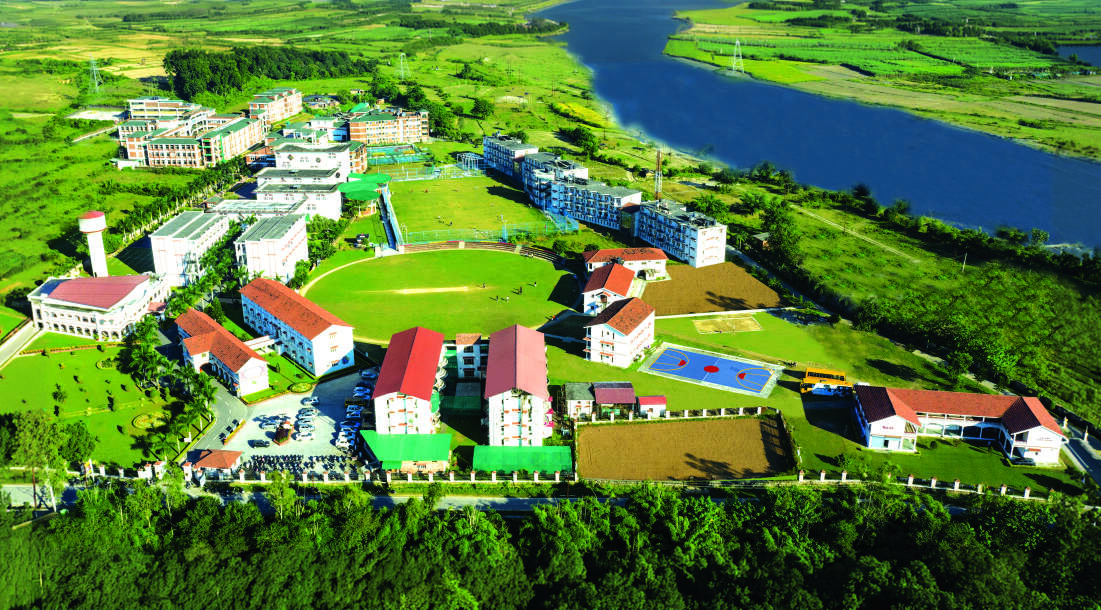
When India completes 100 years of independence in 2047, the country’s success will depend partly on how well it prepares its young population for an economy shaped by artificial intelligence, automation and rapid technological change. The challenge for education will be to keep pace with this change without losing sight of the human qualities that make learning meaningful.Raunak Jain, who is Senior Vice President & Co-Founder of Tulas University, whose work spans school education and higher education through the Tulas Group, this raises a fundamental question: What should a student learn today to remain capable, relevant and independent in 2047?The answer lies in rethinking education across its different stages. Schools must develop curiosity and the ability to think independently. Universities must help students apply knowledge, work with technology and solve problems that do not have ready-made answers.At Tulas International School and Tulas University, this provides a framework for thinking about how education could evolve over the next two decades.
The classroom of 2047 will look different
Imagine a classroom in which students do not all follow the same learning path. Artificial intelligence helps identify where a child is struggling, offers additional practice and allows teachers to understand individual learning needs. A student studying science can explore a virtual laboratory, while another uses digital tools to investigate a local environmental problem.Such classrooms may become increasingly common by 2047. AI-enabled platforms could make learning more responsive, while simulations and digital collaboration could help students understand concepts that are difficult to teach through textbooks alone.Yet the real change will be in how students are expected to learn.For years, academic success has often been closely associated with examination scores, the ability to remember information and the completion of a prescribed syllabus. These will continue to have a place in education, but they may become less sufficient measures of a student’s capabilities as AI makes information easier to access and process.The greater advantage will belong to students who can question an answer, test an assumption, connect ideas and make sound decisions.This is where Jain’s educational vision finds its relevance. Preparing students for 2047 requires institutions to think beyond the immediate demands of examinations and employment. They must consider how young people will continue learning in a world where the knowledge and skills required for work can change several times during a career.
Tulas International School: Where future-ready thinking begins
The foundation for this transition must be laid during childhood.At Tulas International School, the long-term opportunity is to prepare students to grow up in a technology-driven world without allowing technology to define the limits of their learning.A child introduced to AI should understand more than how to use a tool. The child should learn how the tool works at a basic level, where its answers may be unreliable and why information must be checked before it is accepted.This approach can be applied across subjects. Students could use digital simulations to understand scientific processes, analyse information to study social problems and work on projects that require them to present evidence for their conclusions. AI could help teachers provide individual feedback, while classroom discussions, reading and collaborative activities develop communication and judgement.The objective is to make students active participants in their education.For Jain, the broader question is how schools can prepare children for a future that cannot be predicted in detail. A student entering school today may work in professions that do not yet exist. Preparing that student for one fixed career would be a limited response. Developing the capacity to learn, adapt and think independently would be a more durable investment.This also places greater responsibility on teachers. Technology can assist with explanations, practice and assessment, but teachers remain essential in helping children develop discipline, confidence, empathy and a sense of responsibility.The school of 2047 may use tools that are difficult to imagine today. Its central task, however, will remain familiar: helping children develop into thoughtful and capable adults.
Tulas University: Connecting technology with real-world problems
The same philosophy must continue into higher education, where students begin to apply their knowledge in professional and social settings.Tulas University, based in Dehradun, represents the higher education side of this vision. Its institutional role provides an opportunity to explore how technology can become part of learning across disciplines, rather than remain confined to specialised technical courses.Consider a management student examining a business decision. AI tools could help analyse market information and compare possible strategies, but the student would still need to judge whether the data is reliable, understand the assumptions behind the analysis and explain the final recommendation.An engineering student could use simulation tools to test a design before building a prototype. A law student could examine how emerging technologies affect privacy and accountability. Students from different disciplines could collaborate on a common problem, bringing technical, economic and social perspectives to the same discussion.These examples illustrate a possible shift from education centred mainly on the completion of a degree to education that also demonstrates what a graduate can do.Projects, research, internships and practical assignments could become stronger indicators of a student’s ability to apply knowledge. Universities would need to assess not only the final answer but also the reasoning behind it.The opportunity is to make technology serve this larger purpose. AI should help students explore more possibilities and test their thinking, while universities provide the academic discipline needed to distinguish a plausible answer from a sound one.Jain’s vision for this future can be expressed in the following terms:“By 2047, the real measure of an educational institution will be the kind of people it prepares for the world. AI will change how we access knowledge, how we work and how we solve problems. But our responsibility is to ensure that students develop the judgement to question information, the confidence to think independently and the ability to use technology responsibly. At Tulas, the larger vision is to connect the development of young minds at school with the practical application of knowledge at university. Technology should expand what a student can achieve, while education should teach that student what is worth achieving.”
Why does the transition matter to India’s economy?
The future of education is closely linked to India’s economic ambitions. The country will need people capable of working across technology, healthcare, manufacturing, agriculture, finance and other sectors that are likely to change as AI adoption grows. The demand will extend beyond specialists who build AI systems. Professionals in many fields will need to understand how to use these systems in their own work.Educational institutions can help develop this capability by connecting classroom learning with practical problems. They can encourage students to experiment, work across disciplines and understand the consequences of their decisions.The National Education Policy 2020 identifies technology, critical thinking, multidisciplinary education and the development of well-rounded individuals as important parts of India’s educational direction. The larger task is to translate these principles into everyday teaching and learning.There is also an economic question of access. If AI-enabled education benefits only students in well-equipped institutions, technological progress could widen existing differences in opportunity. Teacher training, affordable digital infrastructure, local language resources and responsible use of student data will therefore be essential.Schools and universities must also establish clear boundaries for AI use. Students need to understand academic integrity, privacy, bias and the importance of verifying information. An education system that teaches people to use AI without teaching them to question it would leave an important gap in their preparation.
The human question behind technological progress
There is a risk in discussing the future of education entirely in terms of technology. A classroom may have advanced digital tools and still fail to develop a student’s ability to think independently. A university may introduce AI into its curriculum without changing how students are assessed.The quality of education will depend on what these tools help students achieve.Can a student explain an idea in their own words? Can they recognise when an AI-generated answer is wrong? Can they work with someone who disagrees with them? Can they make a decision when the available information is incomplete?These abilities will remain important even as technology becomes more capable.For Tulas International School and Tulas University, the opportunity is to connect the early development of these habits with their application in higher education. The school can provide the foundation through curiosity, communication and independent thinking. The university can build on it through research, practical learning and professional problem-solving.The institutions have different roles, but the underlying purpose is connected: to prepare learners who can use knowledge responsibly and adapt as the world changes.
Looking towards 2047
India’s centenary is still more than two decades away. No institution can predict exactly what classrooms, careers or technologies will look like by then. But education leaders can decide what they want students to be capable of when that future arrives.For the leadership team at Tulas Group, the opportunity is to treat AI as a means of expanding human capability and to make the development of young minds the central purpose of education. Tulas International School and Tulas University provide the institutional context in which that vision can be pursued, from a child’s first questions to a university student’s first major professional challenge.The measure of success will not simply be how much technology an institution adopts. It will be whether its students leave better prepared to think, learn and make responsible decisions.By 2047, India will need people who understand AI and can use it effectively. It will also need people who know when to question it, how to apply their own judgement and why the consequences of a decision matter.That is the larger task facing education: preparing a generation that can work with technology without surrendering its ability to think for itself.












Leave a comment