



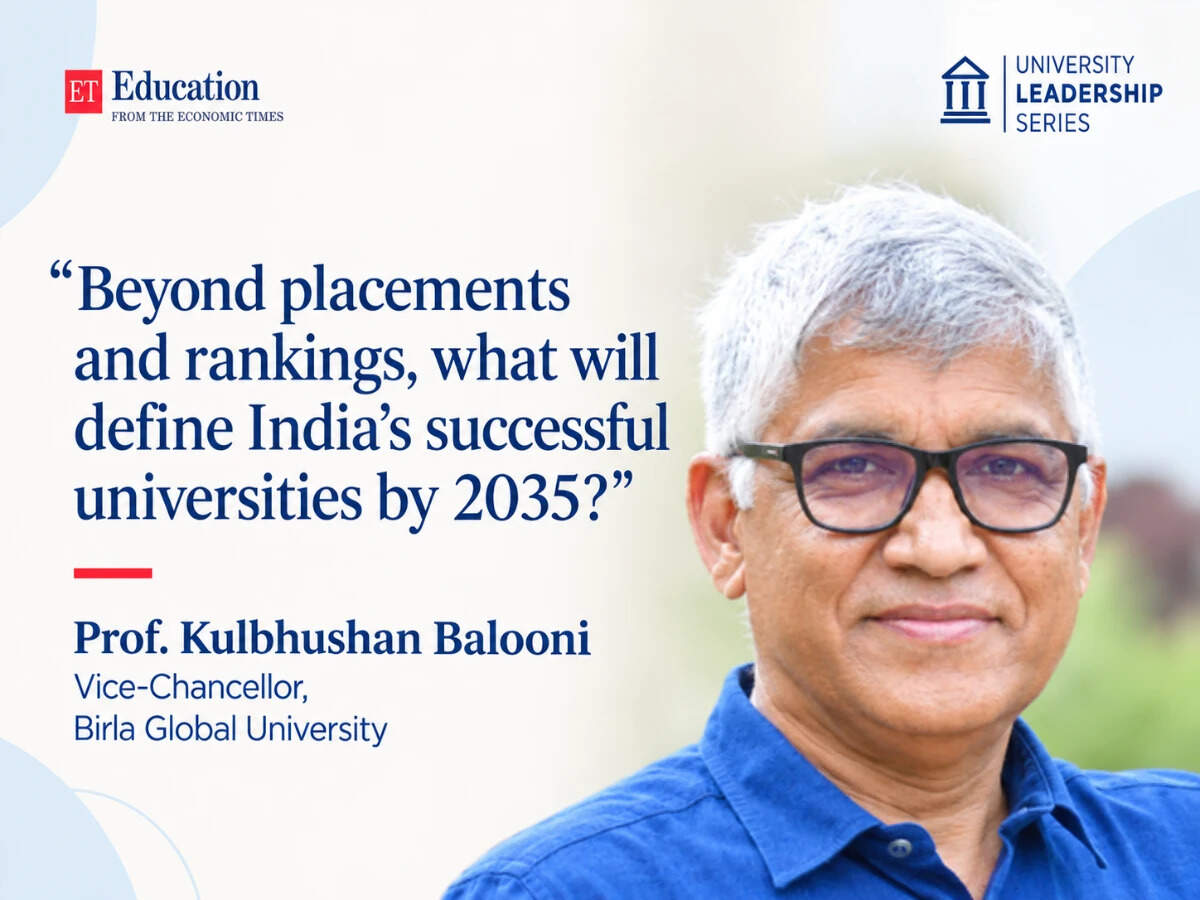
India’s higher education system has expanded significantly, with more than 1,200 universities catering to a growing demand for access and opportunities. However, expansion alone does not necessarily translate into institutional excellence. Questions around academic quality, governance, industry engagement, research outcomes and graduate employability remain central to the sector’s evolution.For Prof Kulbhushan Balooni, Vice-Chancellor of Birla Global University, who has led institutions across both the IIM system and private higher education, the challenge lies in building stronger connections between teaching, research, industry engagement and governance. He believes universities must move beyond measuring processes, enrolment and placement headlines to focus on learning outcomes, academic autonomy and the long-term capabilities they build in graduates.In an interview with ETEducation, Prof. Balooni discusses the structural challenges facing Indian higher education, how AI should reshape teaching and assessment, why employability cannot be left to the final semester, and what will distinguish successful universities by 2035.Q. You have led both IIMs and a private university. From that vantage point, what is the biggest structural challenge holding Indian higher education back today?Prof Balooni: From what I’ve seen, the biggest problem with structures is that teaching, research, industry engagement and governance are still largely treated as separate activities. Individuals are making a concerted effort at all those levels, but the links between them are not that strong.India has great talent and some good institutions, but they don’t reach that level of excellence. It’s easier to measure process than outcomes. Learning quality, useful research, and employability and social impact are frequently secondary concerns.The road ahead lies with universities that have true academic autonomy, sound professional governance, and accountability for outcomes in terms of the quality of learning, the knowledge produced, and the impact of graduates. It takes time and effort to develop that habit. The trend across institutions shows that building structural changes is desirable, given the rapid shifts around us and rising competition. Yet developing and embedding them takes time.Q. India has around 1,200 universities today. Do we need more universities, or do we need better universities? What should be the priority over the next decade?Prof Balooni: We need both, but we must have quality first. There is a need for new institutions, in new locations and new activities that aren’t being met. But when no clear purpose guides expansion, it simply increases the number of degree holders.Over the next ten years, attention should focus on institutions with differentiated missions. Some are to be recognised for a solid undergraduate programme, some for their research output, some for applied learning and industry service, and others for regional contributions.There shall never be a lack of purpose, good faculty, curricula that are relevant to the school’s mission, or good governance or evidence of student learning outcomes. Shared facilities, joint programmes and credit mobility can enhance capability throughout the system.Numbers aren’t everything. Expectations from universities have risen sharply everywhere, not just in India. For all-round growth, institutions will have to confront the structural issues that hold them back.Q. AI is reshaping every profession. Beyond launching AI courses, how should universities redesign teaching, assessment and faculty development to remain relevant?Prof Balooni: AI should be an integrated, not just an isolated course. It needs to be woven through the curriculum and instruction of all disciplines. The pedagogical approach to teaching should shift from content delivery to facilitating student inquiry, application, problem construction, and problem solving.The roles of faculty members shift depending on the situation, from the main lecturer to the mentor, the learning designer to the critical guide.The actual redesign is in the assessment. If you can have the information at your fingertips, how is the memory-based exam going to matter? We need to be able to critically assess AI-generated work, engage in live problem-solving, oral defence, projects, simulations, etc. The student’s reasoning, evidence and ethical judgment should be judged.Faculty development should be ongoing and domain-specific, and should include the use of AI tools in pedagogy and research, data ethics, privacy, and issues of academic integrity.We have introduced an AI course as a multidisciplinary offering in the first semester across all academic disciplines at Birla Global University, in collaboration with the Confederation of Indian Industry (CII). This is taken forward in a decentralised manner by the AI Task Force. The purpose is to augment judgment, creativity, and responsible decision-making, not to take the place of human intelligence.Q. Employability remains one of the biggest concerns for students. In your view, where is the disconnect today: curriculum, industry engagement, faculty, or student expectations?Prof Balooni: The problem is that the four are not very well integrated. There is a long way to go with curricula to meet industry needs. Often, only guest speakers and final placements are part of industry engagement. Faculty don’t always get recent, structured exposure to practice. Occasionally, students see the degree as the goal and not the journey.Employability cannot be manufactured in the final semester. It needs to be developed through communication, digital skills, critical thinking, teamwork, and good planning and design, with practical exposure from the very start.Each programme must have a clear idea of the skills that its students will possess. The learning outcomes should be used to evaluate internships, and industry professionals should influence the curriculum, mentor students, and co-create with them.It’s the students’ responsibility to understand that a degree does not make them employable. Universities provide opportunities, and students develop the skills, flexibility and professionalism that are the keys to making those opportunities careers. Additionally, faculty need regular exposure to industry.Q. The debate around placements often focuses on the highest salary package. What metrics should universities and students look at to judge the real quality of an institution?Prof Balooni: The highest package is an outlier, not an indicator of institutional quality. The more crucial values are the median salary, the overall placement rate, the quality of the job, the diversity of jobs in the sector and the fit of the job to the academic programme.For universities, results should be published for the entire class and not just the top students. We also need to look at the last 20 per cent of the batch, the students who rarely feature in placement headlines but still leave with a degree. What outcomes they secure and whether the institution meaningfully improved their chances are part of judging real quality.Students should also consider the quality of the internship, the amount of exposure to and mentoring by industry professionals, faculty, and research opportunities (if applicable), and the quality of career support.The first salary is less important than longer-term measures such as career progression, entrepreneurship, higher education opportunities, work-life balance or employer feedback. A strong institution does not simply place students in the system; it enables them to develop, evolve, and lead in the future. The true measure is the added value for each pupil.Q. Having built and led institutions at different stages of their journey, what differentiates universities that sustain excellence from those that plateau after initial success?Prof Balooni: I feel that if it remains in the hands of a select few, it is not in the university’s best interest to maintain excellence; it should be institutionalised. It is possible to establish early momentum based on committed people. Still, only capable faculty, a spirit of responsibility, strong systems, and a culture of accountability will lead to long-term success.The good ones invest in people, develop depth in specific areas, and don’t let the latest ‘trends’ get the better of them. They listen to students, employers, alumni and outside experts, and they tweak what doesn’t work.Reputation can replace further innovation, too much centralisation in decision-making, and the belief that visibility is more important than academic quality are signs that institutions are beginning to plateau.No excellence is ever lasting; it has to be refreshed. Reliable structures can be achieved through doable policies, genuine student involvement in education and on campus, and external assessment; this must be followed by ongoing development rather than merely a display.Q. Looking ahead 10 years, what will define a successful university in India? Which institutions do you think will thrive, and which risk becoming irrelevant?Prof Balooni: A successful university in 2035 will be more like a learning ecosystem than a degree delivery machine. It will develop solid academic knowledge and skills, technological literacy, learning through practice, research, or entrepreneurship as appropriate, and the practice of ethical judgment. It will also work for professionals who are constantly looking to upgrade their skills.Successful institutions will have a clear purpose, sound governance, a robust faculty and meaningful collaborative relationships with industry, government and world-class organisations, ones that result in genuine collaboration, not just signed documents.They will leverage technology to improve learning while maintaining a human touch in mentoring, discussion, curiosity, and critical thinking. Those universities that are stuck in the classroom mode of teaching and in the fixed mode of disciplines and placement headlines will struggle.Reputation and location alone will no longer suffice. Institutions will need to show what they do for students, society, and the economy, and how valuable that work is.Q. What is one widely accepted belief about higher education that you think is fundamentally wrong?Prof Balooni: The notion that the ultimate goal of a university education is to get every student a job is only partially true. Employability must be a matter and universities should train students for their working lives. But a university should not simply set a student up for the first job; it’s supposed to prepare them for a life of change.People, planet and technologies will continue to change. What remains are the skills to learn, think independently, communicate effectively, solve new problems, and make sound decisions.A placement is a ‘short-term result’; education is a capability developed over a lifetime. The best universities create professionals, entrepreneurs, researchers, leaders and responsible citizens. While placement is an important measure of success, it shouldn’t be considered the end goal of higher education.















Leave a comment