


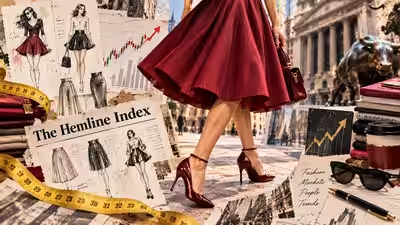
As wacky as it sounds, fashion and the economy have been linked by an unusual theory for nearly a century: the Hemline Index. In one of the strangest attempts to study economy, the theory proposes: skirts get shorter when times are good and when the economy struggles, hemlines head south.A strong economy supposedly brings confidence, higher spending and a greater appetite for experimentation. When times get tough, caution takes over and fashion follows suit, with skirts becoming longer and more conservative. When the economy is bullish, the hemline goes up; when it turns bearish, it comes down.Fashion history offers plenty of examples that seem to fit. The economic expansion of the 1950s coincided with rising hemlines, and the booming 1960s brought the mini-skirt into the mainstream. As economic troubles emerged towards the end of that decade, floor-length hippie skirts gained popularity.The pattern appeared again in the 1970s: the Arab oil embargo and rising inflation in 1973 coincided with a stock-market slump and the popularity of long maxi skirts. More recently, short baby-doll dresses were in vogue around 2006, when the US housing market peaked. Long, flowing dresses returned as the market collapsed in 2007.

Line up hemlines against major economic cycles and the theory can look surprisingly convincing. But merely a pattern is not necessarily a predictor.So, can a skirt really tell us where the economy is headed?
When fashion met economy
The theory was introduced in 1926 by Wharton Business School professor and economist George Taylor, who argued that the length of women’s dresses moved in line with the economic cycle. It was a fitting time: the Roaring Twenties saw flapper dresses bring knee-length skirts into the mainstream. After the stock market crash and the onset of the Great Depression, skirts fell dramatically and longer, more conservative styles came back.Several explanations have been offered. One is that in prosperous periods women could afford silk stockings and were more likely to wear shorter skirts to show them off. In tough times they could not afford them and covered their bare legs with longer skirts. Another is that prosperity simply gives consumers and designers more freedom to experiment.
The pattern was later linked to other cycles. The postwar boom and the 1960s saw the rise of the miniskirt, while the oil crisis was followed by a shift towards longer smock dresses and tunics. The 1980s brought another period of shorter hemlines alongside the so-called millionaire boom. These episodes helped establish the Hemline Index as a popular theory, though a recurring pattern is not necessarily proof of an economic relationship.
Testing the hemline
The Hemline Index might have remained a fashion-world urban legend if researchers had not tried to test it.A 2010 study by Marjolein van Baardwijk and Philip Hans Franses of the Econometric Institute at Erasmus School of Economics did exactly that. Instead of relying on a handful of famous fashion moments, they collected monthly hemline data from 1921 to 2009 and compared it with the NBER chronology of economic cycles.They used five categories of dress length: mini, ballerina length, below the knee, full length or ankle, and floor length.Though their findings did not completely kill the theory, the relationship was not the one you might expect. The economy appeared to lead the hemline by about three years, so a change in economic conditions did not show up immediately in skirt lengths.That lag makes sense: a designer creates a collection, it appears on a runway, buyers order it, manufacturers produce it and eventually it reaches shops. The study itself noted that fashion could be designed one or more years before it becomes ready-to-wear.Today’s skirt might be responding to yesterday’s economy.The researchers concluded that prosperity was associated with shorter hemlines and poor economic conditions with longer dresses, with a lag of roughly three years. They found no evidence that hemlines themselves affected the economic cycle. A woman wearing a miniskirt does not cause the stock market to rise.Thankfully, the Sensex is safe from the wardrobe choices of the country.
Why hemlines change with economy?
But fashion has a mind of its own
The theory has been criticised as too simplistic. Fashion changes for many reasons, and skirt length is hardly controlled by GDP, stock prices or recession dates.Ranen Banerjee, partner and leader, economic advisory, PwC India, calls it “not a very well established index” that may have correlated with economic performance only during some periods in the western world.There is, however, a possible behavioural explanation.Banerjee told TOI, “The psychology behind this, though not established, could be that people would be more confident and go out to shop, dine and other leisure activities where they would like to look more fashionable and hence shorter hemlines, while in not so good economic times, they would be more indoors and hence may wear longer skirts.”This makes the theory less about skirt length and more about consumer confidence and discretionary spending.Dr Gaurav S Ghosh, associate partner at Grant Thornton Bharat, points to what economists sometimes call broader societal sentiment or “animal spirits,” when people feel optimistic and confident, fashion may become more expressive, and shorter hemlines could be one manifestation.Another explanation is social liberalisation, since wealthier societies can become more socially liberal and that can show up in clothing. But Ghosh notes these explanations can fall apart under scrutiny.The biggest issue is that fashion cycles and business cycles are not necessarily the same thing. A skirt can become shorter because designers decide shorter skirts are fashionable, and a long dress can return because consumers like it. Neither requires a recession or a boom. Even measuring the index is complicated.
As Ghosh says, “Hemlines rise and fall in fashion cycles, which may or may not correlate with business cycles. Measurement is complex.” What counts as the hemline of an economy: retail sales, fashion magazine spreads, Google searches, runway collections, or what women actually wear on the street? Each could tell a different story.Meanwhile, what is considered fashionable has also changed.There was a time when trends could be described through a narrow set of dominant styles. Today, long and short skirts can be fashionable at the same time. Western fashion has become more diverse, and global fashion increasingly incorporates different cultural preferences. Trends can also have nothing to do with economics.By the late 2010s, the polo neck and high collar had become a major fashion statement, so the neckline, rather than the hemline, was doing much of the talking. A dress can be long because maxi dresses are in, a skirt short because minis are back, and neither tells us what GDP will do next.As Ghosh sums it up, “I would put most of this in the category of ‘pop’ economics: fun reads, but not to be taken too seriously.” The index is an intriguing lens on consumer behaviour, but it is not a substitute for conventional economic indicators.
Does the hemline travel to India?
Thankfully, Sensex is safe from the wardrobe choices of the country.With India’s diverse fashion staples, the Hemline Index gets even more complicated. Skirts are not the dominant form of women’s clothing across the country. India has enormous regional, cultural and economic diversity, and women’s clothing includes sarees, salwar suits, kurtas, lehengas, western wear and many combinations of these.So what would an Indian Hemline Index measure? A short skirt in Mumbai? A saree in Kolkata? A kurta in Delhi? A lehenga in Jaipur? The answer is not straightforward.Asked whether the index applies to India, Ghosh said: “Absolutely not! In fact, I would argue that it is only contextually relevant to WEIRD countries. Skirts, high hemlines or not, are uncommon in most of the country.” That does not mean fashion cannot tell us anything about the Indian economy. It means the Western Hemline Index cannot be mechanically transplanted into India.Banerjee suggests looking at women’s discretionary spending rather than skirt lengths. Cosmetics could provide a more useful basket, since perfumes, lipstick and eyewear are discretionary purchases.
His idea is essentially a cosmetics index: track a basket of discretionary beauty and fashion-related purchases and see whether spending changes with financial confidence. “We could possibly have a cosmetics index with a basket of cosmetics items like perfumes, lipstick, eye wear etc. given these are discretionary spend items and track the index to observe any significant correlation.”This follows the same philosophy as the Hemline Index but removes the cultural problem. Instead of asking “Are skirts getting shorter?”, the question becomes “What are people willing to spend money on when they feel financially comfortable?” That is a much broader question, and one that can apply across cultures.
Lipstick, hair dyes and more indicators
If skirts are one strange way to read the economy, they are not the only ones. There is a whole family of unofficial, consumer-based indicators that try to spot changes in the economy by observing what ordinary people buy, or stop buying.
The lipstick index
During difficult periods, consumers may replace expensive purchases with smaller luxuries, so someone might buy lipstick as an affordable treat. The idea gained attention after Estee Lauder saw lipstick sales rise following the decline in consumer spending after the September 11 terrorist attacks.
Men’s underwear
Men are more likely to postpone buying new underwear when money is tight because the purchase can be delayed. Sales reportedly fell during the Great Recession and again during the pandemic, according to the material supplied. The logic is that when household budgets tighten, people postpone non-essential purchases.
Champagne
Almost the reverse of the lipstick index. When consumers feel comfortable, they spend more on luxury products; when the outlook turns uncertain, expensive celebratory purchases take a hit. A decline in champagne sales can therefore signal that consumers are becoming more cautious.
Hair dye
Hair colour is another small luxury that can disappear when budgets get tight. Someone between jobs or cutting household expenses may decide an expensive salon colour treatment can wait. On ground level, the indicator is about discretionary spending, not just hair.
Dining out
Look around the office refrigerator. More packed lunches, fewer restaurant meals, more home cooking and greater use of lower-priced stores can all point to price-conscious consumers. It is the economy showing up in the lunchbox.
What’s Indian equivalent to the hemline index?
Real estate development
his one moves from consumer behaviour to business activity. In a boom, developers may have easier access to financing and more confidence to start large construction projects; when conditions deteriorate, projects can be delayed or cancelled. It is still indirect, but unlike lipstick or hemlines, it is tied to actual economic activity.
Desi twist for the Hemline index
India may not have a simple equivalent of the Hemline Index. What people wear and spend on is often driven by culture, traditions and social expectations, not just the ups and downs of the economy.Ghosh told TOI, “I would not consider sarees vs western wear because of the cultural component. A shift to western wear is a longer-term cultural trend, which is separable from the business cycle.”Other possible Indian indicators come with complications:
Sarees versus western wear
It is tempting to say a shift towards western clothing indicates a stronger economy, but Ghosh argues this too would be misleading because the change can be part of a longer-term cultural trend rather than a response to the business cycle.
Wedding spending
Indian weddings can involve enormous expenditure, but budgets are shaped by prestige, family expectations and community norms. Families may even borrow to fund weddings, making the spending relatively insensitive to the business cycle.
Gold
Gold is not just a luxury purchase and can also act as an inflation hedge. High inflation or high gold prices can increase gold expenditure without households enjoying good economic times.An interesting measure could be night-time luminosity. According to Ghosh, the measure “has been used recently to proxy economic performance with some credibility. Other measures might include e-way bill volumes, vehicle registrations, and other transportation indicators.”The search for an Indian equivalent brings us back to the same lesson: a quirky economic indicator only works if the behaviour it measures is actually connected to the economic phenomenon being studied.Evidently, the Hemline Index may be a fascinating way to look at the economy, but its real value lies more in the questions it raises than in its ability to predict what comes next. At best, it offers a quirky window into consumer confidence, changing tastes and spending behaviour; at worst, it is a neat pattern that looks stronger in hindsight than it is in reality.














Leave a comment