



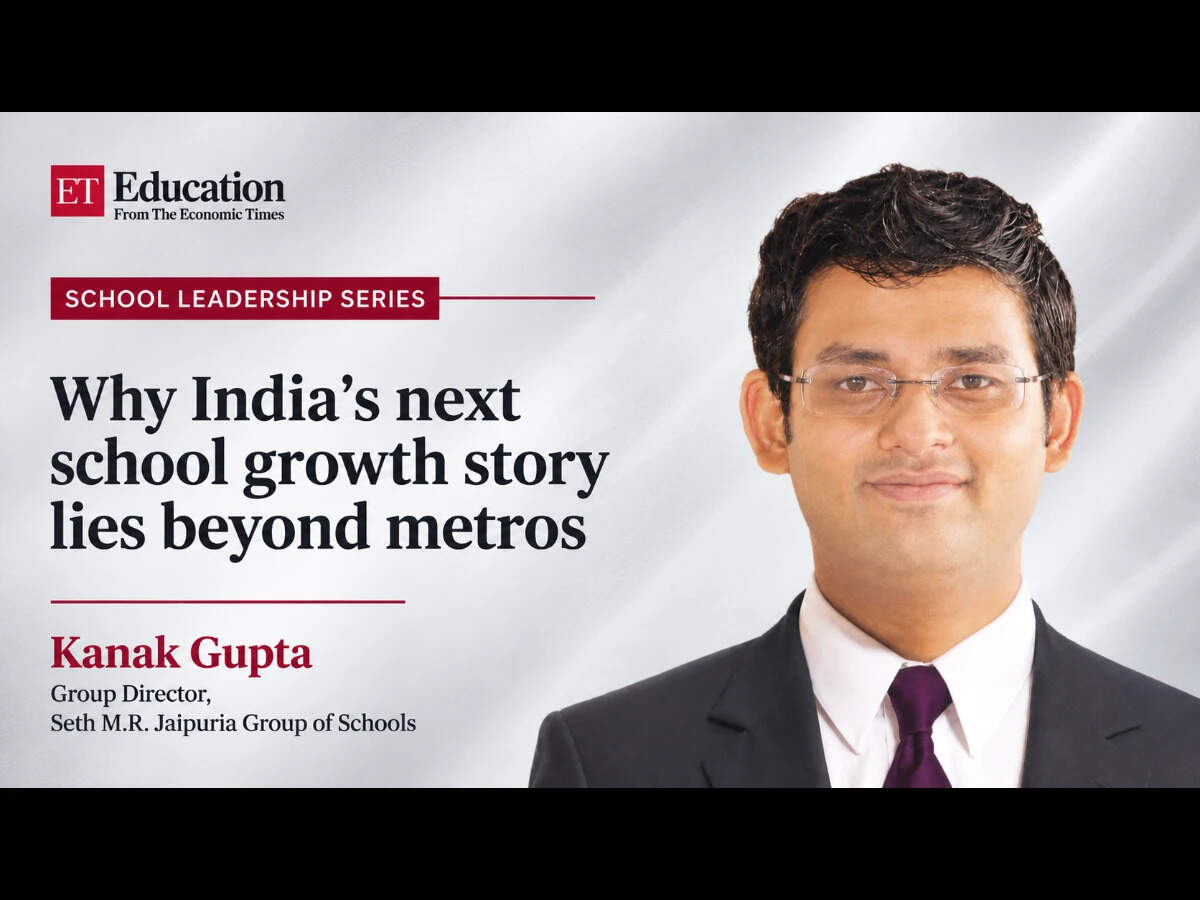
India’s next big opportunity in school education may lie beyond its metropolitan cities. As aspirations for quality education grow in smaller towns, school networks are increasingly looking at Tier 2 and Tier 3 markets to expand their footprint. Seth M.R. Jaipuria Group of Schools, which has 91 schools in its network, of which 74 are operational, and caters to around 75,000 students, is among those betting on this shift.In an interview with ETEducation as part of the School Leadership Series, Kanak Gupta, Group Director of Seth M.R. Jaipuria Group of Schools, explains why the group chose smaller cities over metros for expansion, how it is building a sustainable school network, and why he believes India’s educational aspirations change every 50 kilometres. He also shares his views on NEP 2020, the commercialisation of education, dummy schools and how AI will reshape teaching and learning.Q. India’s K-12 education sector has seen the emergence of several large school networks. What does it take to build a sustainable school ecosystem at scale, particularly across multiple campuses?Kanak Gupta: The key is maintaining consistency in teaching, learning outcomes and the value system across campuses. For us, the focus has always been on students in Tier 2 and Tier 3 cities. We realised that aspirations in these locations are extremely high. People want access to the quality of education available in Delhi and other metropolitan cities. With technology and AI, a child in Bahraich can compete with a child in Delhi.When we started, we were advised against focusing on smaller cities because it would not be sustainable and that we should not operate below a certain fee point. But India is a very large and diverse market. Its requirements and aspirations change every 50 kilometres.We adopted the franchise model and currently have 91 schools in our network, of which 74 are functional. We organise four training programmes and two audits every year, supported by a learning management system and other technological interventions.We see franchising as a partnership rather than a business transaction. Our audits are developmental exercises, not fault-finding exercises. We also organise 16 national events annually. We have around 75,000 students and approximately 4,500 teachers. Last year, 53,000 students participated in our national events. Parent engagement is another important part of our ecosystem, and we actively seek feedback through initiatives such as the Jaipuria Parent Ambassador Programme.Q. How do you balance the business realities of running a large school network with the responsibility of making quality education accessible and affordable?Kanak Gupta: I am a strong believer in the economics of education. The economics have to make sense. Anyone investing money in a school must understand that it is a back-loaded model. Returns come gradually.A school has to demonstrate results through academic performance, the overall development of children and the trust it builds within the parent community. Admissions are important, but they should not be the holy grail. We want every school to become a school of choice.Financial sustainability also allows schools to invest in better laboratories, teacher training, student expeditions and innovation. When the pandemic happened, we were already equipped to manage the transition to online education because we had invested in technology earlier.I am not suggesting that education should be driven purely by a business mindset. The ethos of education must work alongside its economics. We have been in education since 1945 and understand that it is a slow process. We don’t get overexcited when there is a particularly good academic year or overly disappointed when a year does not go as expected. Education is cyclical.Q. Could you take us through the group’s journey and why you decided to focus on Tier 2 and Tier 3 cities rather than metropolitan markets?Kanak Gupta: The Jaipuria group’s journey in education began in 1945. Over the years, we established schools, colleges and management institutes in different locations.I joined the group in 2010 after working as a management consultant in London. In 2013, when we began evaluating opportunities for expansion, we met several consulting firms. Their advice was to establish K-12 schools in metropolitan cities such as Delhi, Mumbai, Kolkata, Bengaluru and Hyderabad, where they believed returns would be better.I remember getting into the car after one such meeting and telling Srivats Jaipuria that I wanted to do exactly the opposite. We decided to focus on Tier 2 and Tier 3 India.I undertook a 10-day road trip from Lucknow to Ayodhya, Gorakhpur, Siwan, Madhubani and Patna. I visited schools and colleges along the way because I wanted to understand how they functioned and what people aspired to.That journey helped me understand the diversity of India, the educational demand in smaller towns and the opportunities available there. The openness of educators in these locations was remarkable. Nobody looked at us as competition.Our first franchise school came up in 2014. Since then, the network has grown to 91 schools, catering to around 75,000 students. We hope to be close to 100,000 students by 2028.**Q. NEP 2020 has outlined several changes in school education. How much has the policy translated into actual classroom transformation, and what gaps remain?****Kanak Gupta:** NEP 2020 is an excellent document that provides direction for education reforms. One important thing to understand is that NEP is the starting point, not the endpoint.Practices such as teacher upskilling, experiential learning, critical thinking and flipped classrooms were already being implemented by several good schools. NEP has brought these practices into the larger public discourse.However, fundamental changes are still required in the mindset of parents and teachers. Today’s parents and teachers largely grew up in an education system that emphasised rote learning, memorisation and marks. The race for 99% and 100% continues to influence how children are taught and evaluated.I have tremendous respect for Gen Z. They have clarity, are upfront and know how to express themselves. They respond differently, and if they feel a conversation is not happening in the right way, they are more likely to disengage rather than accept everything silently.Students must be given greater agency in learning. They should be allowed to lead, make mistakes and learn from them. We often talk about learning from failure, but it has to translate into actual classroom experiences. Ultimately, implementation has to happen at the institutional and classroom levels.Q. There is a growing debate around the commercialisation of school education. How can private school operators balance financial sustainability with affordability and their responsibility towards parents?Kanak Gupta: The real growth opportunity in school education lies in Tier 2 and Tier 3 India, where there is significant demand. After the pandemic, people are increasingly reluctant to leave their hometowns. If we can provide high-quality education locally and create opportunities for teachers, why should families have to move to metropolitan cities?I think we have given commercialisation a very bad name. Why should a teacher not earn well? Teachers have every right to make a good living. We do not question the remuneration of CEOs in other industries, but often question what a school principal or teacher earns, despite the enormous responsibility they carry.At the same time, commercialisation should have its limits. School fees should be determined by the region and not merely by the brand. We have schools in Jhansi and Varanasi and are expanding into Darbhanga. The fee structures in these locations will naturally differ because local economic conditions and affordability levels are different.A national brand cannot have a uniform fee structure irrespective of location. School fees should grow in line with inflation and the investments required to provide quality education. Schools should compete on value, not merely on cost.Q. Do dummy schools and the growing preference for coaching centres pose a challenge to established school networks?Kanak Gupta: Absolutely. Dummy schools are a significant problem, including for established school networks such as ours.Parents sometimes believe that children can join coaching centres and opt for dummy schooling instead of receiving a complete school education. Some academically strong students are also attracted to this idea because they want to focus entirely on competitive examinations.A considerable amount of teachers’ time goes into counselling parents about this issue. During parent-teacher meetings in senior classes, parents often ask whether they should move their children to coaching centres or dummy schools.If a teacher has to spend 30 to 45 minutes with an individual parent discussing this, that is time that could otherwise have been invested in the child’s overall development. School education must be much broader than preparation for competitive examinations. Students need academic, social and personal development.Q. With AI increasingly influencing how children learn, how do you see the role of schools and teachers evolving?Kanak Gupta: I think everyone is asking the wrong question when they ask whether AI will replace teachers. AI is going to be part of our lives. The more important question is how we use it.If we allow AI to replace human engagement, it will not work. Technology cannot become a substitute for meaningful interaction between teachers and students. I am a big believer in India’s *guru-shishya parampara* because it represents the importance of that personal connection in learning.We should use AI and technology to empower teachers and help students ask better questions rather than simply seek answers. Answers are now easily available. The real skill will be knowing what to ask.I remember an experience involving my daughter, who is in Class 12. She had her first open-book examination and initially thought she did not need to study because she could refer to the book during the examination. However, after the examination, she came home and admitted that she had no idea where to look for the answers.That experience demonstrates an important point. Even when information and answers are available in front of you, you need to know what you are looking for. Schools of the future must develop curiosity, collaboration and the ability to ask meaningful questions.Q. Looking ahead over the next five to 10 years, what will differentiate a successful school from others?Kanak Gupta: All these factors are important. We have traditionally believed that a successful school is one that produces toppers, while an unsuccessful school is one that struggles with admissions. I think the truth lies somewhere in between.A successful school is one that is in a growth phase, is economically viable and provides students with multiple opportunities for engagement and excellence. Academic outcomes, teaching quality, technology and the overall development of children must work together.A school should be able to sustain itself financially while continuously creating opportunities for students to learn, explore and excel.










Leave a comment