


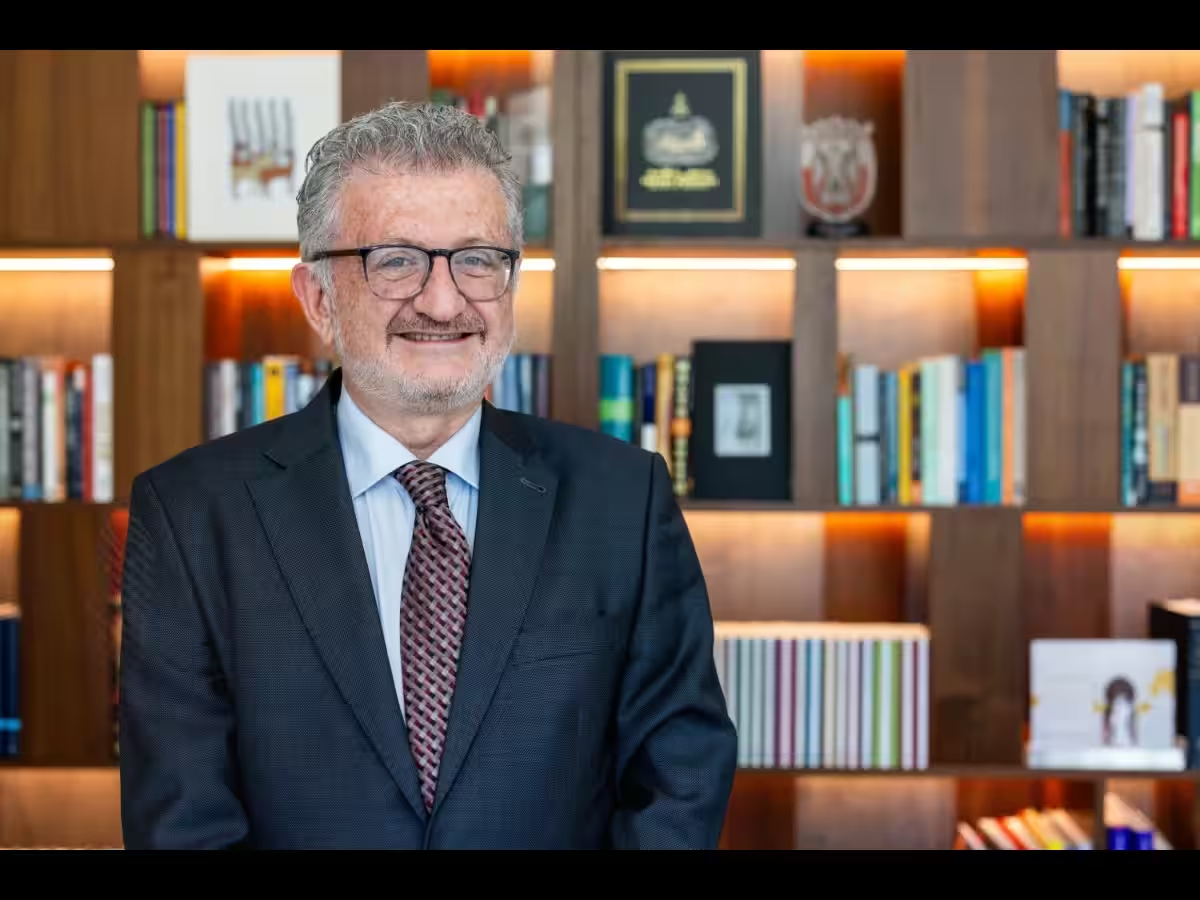
The rapid evolution of technology is challenging some of the most fundamental assumptions about higher education. As artificial intelligence transforms the nature of work, new industries emerge and traditional disciplinary boundaries become less distinct, universities face a larger question than simply whether their graduates are equipped with the right skills. They must consider whether students are developing the intellectual foundations, adaptability and judgement needed to navigate an uncertain future. The emphasis is gradually shifting from preparing students for specific jobs to cultivating individuals who can think critically, connect knowledge across disciplines, question established ideas and contribute to problems that do not yet have easy answers. In this changing landscape, the role of universities is as much about shaping how people think and learn as it is about what they know.In this exclusive interaction with ETEducation, Fabio Piano, Vice Chancellor and Chief Executive of NYU Abu Dhabi, shares his perspective on how higher education must evolve in an AI-driven world. He discusses the growing importance of interdisciplinary learning, the balance between specialised expertise and broader intellectual foundations, the role of research and innovation, and the human capabilities that will remain essential as the future of work continues to change.Piano’s academic and research background spans genomics and systems biology, fields that have increasingly demonstrated the importance of interdisciplinary approaches to scientific discovery. Having played a key role in shaping the university’s academic programmes, he brings a perspective that connects research, liberal arts and sciences education, and the evolving demands of the global knowledge economy.Here are the edited excerpts from the interview.Q. As technology reshapes industries and creates entirely new fields of work, what should universities fundamentally change about the way they prepare students for the knowledge economy?Universities need to prepare students not simply for the jobs that exist today, but to develop the expertise and judgement that will allow them to adapt as knowledge and technology evolve. In an AI-driven world, we will increasingly need people who can understand technology well enough to evaluate its outputs, make informed judgements and remain in control of how it is used.At NYU Abu Dhabi, we offer a world-class liberal arts and sciences education in a global university that is deeply rooted in Abu Dhabi and the UAE. Our students develop depth in their chosen fields while gaining exposure to different disciplines, cultures and ways of thinking. The goal is not to predict the future of work, but to give students the intellectual foundations to help shape it.Q. The boundaries between disciplines are increasingly disappearing – AI is transforming biology, data science is reshaping healthcare, and engineering is intersecting with climate, mobility and society. What does an effective interdisciplinary education look like in practice?Interdisciplinary education has to be more than putting different disciplines next to one another. Students need opportunities to work across those boundaries and understand how different forms of knowledge can come together to address a problem.In practice, this means developing expertise in a particular field while learning to engage with the methods, assumptions and perspectives of others. A challenge such as climate change, for instance, requires scientific understanding alongside insights into economics, public policy and human behaviour. Similarly, applying AI in healthcare involves more than technical capability; it also requires an understanding of clinical contexts and the ethical implications of its use.Ultimately, effective interdisciplinary education enables students to recognise when a problem requires them to move beyond the boundaries of their own expertise and collaborate with others.Q. NYU Abu Dhabi was built around a distinctive model that brings together the sciences, engineering, social sciences, arts and humanities. What has the university’s experience taught you about preparing students for a world where the most important problems increasingly sit at the intersection of disciplines?Our experience has shown that many of the most important questions facing society cannot be answered within a single discipline. Students need deep expertise, but they also need to understand how that expertise connects with other fields.Universities operate within particular social, cultural and economic environments, and the challenges facing a community can provide important questions for teaching and research. At NYU Abu Dhabi, our global outlook and connection to the UAE have reinforced the importance of bringing international perspectives into dialogue with local needs.The university is also part of Abu Dhabi’s wider ecosystem of education, research, culture, innovation and industry. We are on Saadiyat Island, surrounded by institutions that speak to the culture and identity of the place, and we contribute to that ecosystem. We are global in outlook, but deeply rooted in the UAE.Q. Beyond technical expertise, what capabilities do you believe will remain uniquely valuable in an AI-driven economy – whether critical thinking, curiosity, creativity, communication, ethical judgement or the ability to ask the right questions?Expertise and judgement will become more, not less, important. As AI systems become increasingly capable of generating information and solutions, people will need to determine whether their outputs are meaningful, reliable and appropriate. Humanity needs people who can understand what technology is producing and determine whether that output is meaningful, reliable and appropriate. Humanity needs to remain in control.Curiosity is equally important. It drives people to investigate difficult questions, challenge established assumptions and explore possibilities that may not be immediately apparent. Creativity and communication also matter because addressing complex problems often requires people to connect ideas, explain their reasoning and work collaboratively with others.Ultimately, we want students to reach the point where they can look at the boundaries of existing knowledge and ask what lies beyond them.Q. Having played a key role in shaping NYU Abu Dhabi’s academic programmes, how is the university now evolving its curriculum, research opportunities and learning experiences to prepare students for emerging fields such as AI, biotechnology and other knowledge-intensive industries?We are continuing to build an environment where students can connect a world-class liberal arts and sciences education with research, emerging technologies and real-world problems.Research is a fundamental part of this process. We have more than 90 research labs and centres, and our students have opportunities to work alongside faculty on questions at the forefront of areas including health, genomics, sustainability, climate and emerging technologies. Since opening in 2010, our researchers have produced more than 9,200 research publications and filed 335 patents, and NYU Abu Dhabi ranks first in the UAE for publications in the world’s top science journals, based on the Nature Index. Our research community includes four Nobel Laureates. This combination of rigorous education, research and real-world experience also prepares our graduates well beyond their time at the university, with 93 per cent of the Class of 2025 securing employment or further opportunities within six months of graduation.We also connect students with the wider Abu Dhabi ecosystem through partnerships with industry and other institutions. This matters because education should not exist in isolation from the society around it. A university can contribute to a city’s future by bringing together students, researchers, cultural institutions, companies and other organisations around important questions.More broadly, the challenge for higher education is to ensure that students develop the capabilities to contribute to emerging fields while retaining the flexibility to navigate industries and technologies that may look very different in the years ahead.Q. Your own work spans genomics, systems biology and interdisciplinary research. How has working across disciplines shaped your view of what the next generation of scientists, researchers and innovators needs to learn?My own work in genomics and systems biology has reinforced how few important scientific questions can be answered within a single discipline. Progress often happens at the interfaces between fields.That has shaped how I think about education. Students need deep expertise, but they also need the intellectual flexibility to understand another field, collaborate with people who approach a problem differently, and recognise when a question requires a new combination of knowledge.That is why I believe the liberal arts and sciences model remains so relevant. It gives students the opportunity to develop expertise while maintaining the breadth to engage with a much wider set of questions.Q. How should universities balance teaching students skills that are immediately relevant to emerging industries with giving them the deeper intellectual foundations that allow them to adapt when those industries themselves evolve?I think the answer is to give students both depth and breadth. They need to become genuinely expert in something, while also developing the intellectual range to understand how that expertise connects to other fields and to the wider world.A student studying engineering, for example, should have the opportunity to engage with questions in the humanities and social sciences, just as a student in the social sciences should be able to engage with science and technology. That breadth does not dilute expertise. It gives students a broader context in which to apply it.Research is another important part of that equation. Students who work alongside faculty on research questions across disciplines learn not just what is already known, but how knowledge is actually created. That experience of investigating a problem, testing ideas and working through uncertainty is difficult to replace with a list of immediately applicable skills.The strongest preparation for the knowledge economy is therefore not choosing between practical skills and intellectual foundations. It is developing people who have both the expertise to contribute today and the intellectual curiosity to keep contributing as the questions change.Q. If you were advising a student entering university today, what would you tell them to study – and, perhaps more importantly, how would you advise them to approach learning – given how difficult it is to predict the jobs and industries they will enter ten years from now?I would tell them to develop real expertise in something they care about, but not to allow that expertise to become a boundary.Take advantage of the opportunity to study subjects outside your major, work with people who think differently from you, and seek experiences that put your knowledge into a different context. At NYU Abu Dhabi, that can mean undergraduate research, studying through the NYU Global Network, or taking a J-Term course in another country.Most importantly, I would encourage students to become comfortable with unanswered questions. It is an opportunity to move beyond established knowledge, explore an area of genuine interest and create something new.That is also where I think the university experience should ultimately lead: to students who are able to identify important questions that have not yet been answered and have the knowledge, curiosity and confidence to pursue them. That ability to keep learning, work across boundaries and ask important questions will remain valuable regardless of how technology and industries evolve.















Leave a comment