


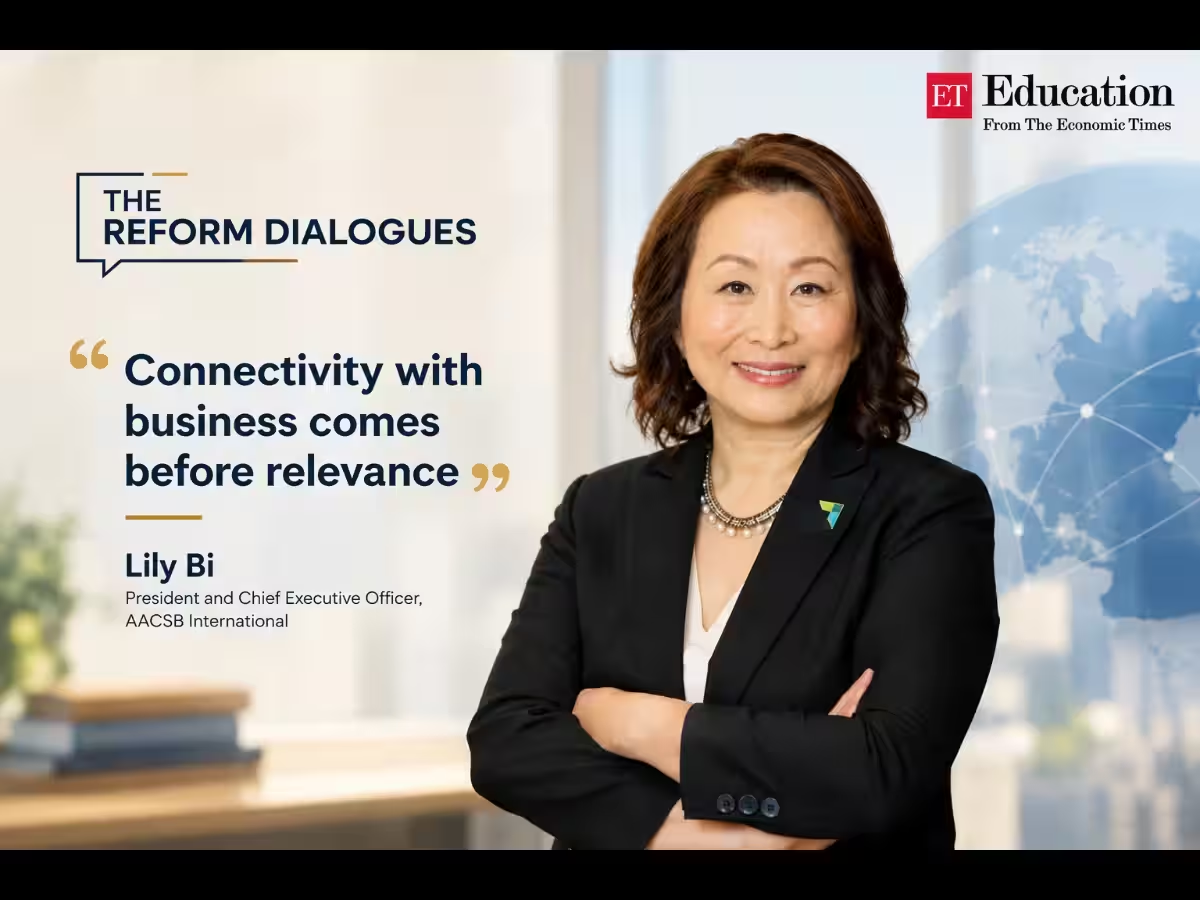
Artificial intelligence is forcing business schools to rethink what they teach, how they teach and what they ultimately prepare students for. Lily Bi, President and Chief Executive Officer of AACSB International, the global business education association and accreditation body, believes the transformation needs to go well beyond adding AI to the curriculum.
AACSB has 1,098 accredited institutions across 71 countries and territories, giving Bi a broad view of how business education is evolving across markets. She argues that business schools need to shift from transmitting knowledge to developing human capabilities such as curiosity, critical thinking and judgment. She also sees a future in which institutions move beyond degree-centric models towards lifelong learning, while becoming more closely connected with business and society.
In an interaction with ETEducation, Bi discusses what business schools should measure beyond rankings and placements, why faculty development and industry engagement will become increasingly important, and how institutions can ensure technology does not come at the expense of human judgment.
Q: India has a market for AACSB, and how has the growth been compared with other nations where there are good business schools?
Lily Bi: I don’t see India as a market. I think India is an important contributor to global business education. I’m sure you know AACSB is a global organisation.
Our focus is accreditation, but we do more than that. The desire, the hunger is there, and every single time I come here I’m always pleased to see many Indian schools. They’re hungry, they want to be part of the global family, and definitely there is huge growth and huge potential for the future.
Q: Business schools are facing pressure from artificial intelligence, changing employer expectations and new models of learning. From AACSB’s global perspective, what are the biggest strategic changes B-school leaders should make now?
Lily Bi: I think all the AACSB schools have been very adaptive. Even though there was some initial resistance from some parts, that’s just normal with a new technology. But by now we’re in year three, almost year four, with AI, and adoption is there.
But if you talk about strategic shift, which is really your question, and how they can shift for the future, I can think about it from three potential areas.
One is moving from traditional teaching of knowledge to developing individual human beings and developing capability, because knowledge is getting more and more abundant and more freely accessible. People can get it from YouTube, they can get it from anywhere.
Knowledge expires quicker than ever, but capability is different. Curiosity and critical thinking are capabilities. So I think that shift is important.
The second one is probably moving from a degree-centred model. The business school is all surrounding the degree. Can we move from that model to a lifelong learning model?
There was a conversation yesterday talking about business education. Just imagine in 2035. Does it make sense that business schools still continue focusing on the three- or four-year degree or the two-year MBA, or make it a service model, subscription model, a lifetime model? People always need to learn, unlearn and relearn. So if students can continuously come back, I think that will be more helpful. That’s lifelong learning.
The third one, which I strongly believe is important, is moving from being institution-centred to being stakeholder-focused. In other words, being less inward-looking but focusing more on business and society and connecting with business and society.
I think that’s the key for business schools to think about. When they design the curriculum, what is its relevance for business and society, and what are the expectations of the learner? All of those are getting more and more important. Schools need to focus on connectivity with business and society.
Q: AACSB accreditation is often seen as a mark of quality. What does a genuinely high-quality business school look like today, according to you, and what should Indian B-school leaders be measuring beyond rankings and placements?
Lily Bi: Our standards go beyond just quality. Our standards take a comprehensive approach to every single area, from the foundation of the institution to assurance of learning and the quality of learning.
But there is another element on top of quality, and that is impact. Impact comes from teaching. Is the teaching truly having an impact on young students, not only in terms of knowledge, capability and skills, but also their personality? There is also research impact. There is so much academic research. How much impact does it generate for society?
Another is societal impact. I know a lot of business schools in India are actually doing way more than what I see in other parts of the world. They have students going to disadvantaged areas and villages to help them understand what that means for society as a whole and how they can help society after they graduate. So quality is one element, but impact is another increasingly important element.
Q: Artificial intelligence is forcing business schools to rethink their curriculum, pedagogy and even faculty roles. How should B-school leaders approach this transformation without allowing technology to come at the expense of critical thinking, leadership and human judgment?
Lily Bi: Artificial intelligence is a conversation about everything, but nobody knows where this will go. So we’re all dealing with uncertainty.
But does it make sense that humans are going to do the humans’ original job? Let AI automate as much as it can, but let humans focus on what is your curiosity to ask the right question. Before having AI develop an answer, you apply your judgment. The whole thing, from the beginning to the end, is AI governance. AI is not accountable for the result. AI will not go to prison. Humans get to prison, unfortunately, whether we like it or not.
So I think for business schools, it is very important to think about a well-rounded person.
Gandhi spoke about education as the all-round drawing out of the best in an individual, including the body, mind and heart. I think that’s more and more important today, even though that’s not new. Humans need to go back to the human original purpose, and education needs to focus on the being part of individuals.
Q: Employability remains one of the biggest measures of success for Indian business schools. What should institutions be doing differently to ensure their programmes remain aligned with the jobs and skills that industry will need five to 10 years from now?
Lily Bi: First of all, all business schools need to connect with the business world. At least my understanding is that almost all business schools have an advisory council or advisory board with business people coming in. But some of them may be too performative and ceremonial instead of having real substance.
Think about it. If you only meet twice a year, coming here and meeting for one or two hours, it may not have true substance.
I think engagement with the business world should be a requirement for all faculty members, not selective and not optional. Because without that engagement, where does relevance come from? How do you update the syllabus? Where do you get the research topics? I think that’s the most important thing.
And there is the issue of speed, because the speed of change in the business world is typically faster than in the academic world.
And it will get worse. It will get faster. So how can we be in real time? That’s why connectivity comes before relevance. We need to figure out the mechanism for connecting with the business world.
Q: Indian business schools are increasingly pursuing international accreditation, partnerships and global exposure. What separates institutions that are genuinely becoming global business schools from those that are simply internationalising on paper?
Lily Bi: I would be very sad if a school just focuses on the paper. But you must be experiencing a lot of applications.
We do have a lot of applications. That’s why our process is not one year. You know, what is the average process for them to get international accreditation? It is 6.2 years.
So you better have that desire. If you just want to play the paperwork game, you will be exhausted. And once you get accreditation, it’s not over. Just like a chartered accountant in India, you have continuous education. It is the same for business schools.
Once you get accreditation, you have to continue. You have to submit an annual report, there is a midterm report, and there is a re-accreditation process. So I think the whole thing requires commitment and determination. Otherwise, you’re wasting your own time.
It’s a long-term commitment; it’s not a quick thing.
Q: For B-school leaders planning for the next decade, what are the three areas you believe deserve the greatest investment? Is it faculty, research, technology, industry engagement, internationalisation or something else?
Lily Bi: I think faculty will be the number one priority. There are so many changes and we ask a lot from faculty. Traditionally, they probably just focused on teaching and research. Now we ask them to do mentoring.
I think mentoring will become more and more important because knowledge can be obtained from everywhere. But mentoring, you may not be able to get that. Who is inspiring? Who is mentoring the student? So retraining the faculty, I think, is the number one priority for business education.
Research, technology and industry engagement are also important. The second one, as I already mentioned, is industry engagement. I believe that’s the key.
Faculty may have industry experience or they may not, but that engagement is needed. Or maybe there should be a mix of faculty. You can have some pure academic faculty and some with more industry experience, so that connectivity is the second one.
The third one absolutely has to be technology.
Some may be more proficient in technology and some may not. But as an institution, they need to invest more in technology and how to use technology in everything they do: teaching, research and institutional management.
Q: How are things moving in other parts of the world, such as Europe, the US and other Asian countries? How do you see business schools there responding to these changes?
Lily Bi: We just finished a global dean survey, which we conduct every other year. What I recognise is that there are some differences. For everyone, the top priority is AI readiness.
However, when it comes to reputation, we talk about rankings and everything. I think Asian schools are focusing more on reputation and rankings. Another thing is global connectedness, and Asian schools are focusing more on that than other parts of the world.
I think it’s because they want to connect. European and US schools, in a sense, already have that connection and already have that reputation.
There are some differences, but everybody recognises that the financial feasibility to sustain business schools and technology readiness are common priorities. But in terms of reputation and connectedness, there are some differences.















Leave a comment